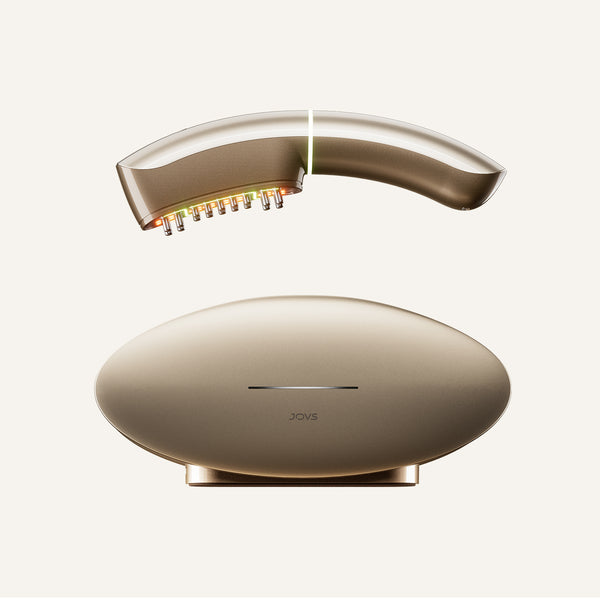


EMS may help improve jawline definition, but it is not a solution for every type of sagging.
The strongest evidence so far comes from a 2024 clinical study in which facial neuromuscular electrical stimulation (NMES) produced measurable improvements in both jawline angle and submental volume after eight weeks of use.
what exactly is EMS improving?
A softer jawline can develop for several reasons. Skin may become less elastic, facial fat can shift, and the structures beneath the skin also change with age. EMS mainly works by stimulating muscle contractions, so its potential benefits are likely to be most relevant when changes in muscle activity and facial support are part of the picture.
Facial EMS Shape Jawline
A 2024 prospective split-face study published in the Journal of Cosmetic Dermatology looked directly at what facial NMES could change over time.
Twenty-four women aged 30–59 used a high-frequency NMES device on one side of the face for eight weeks. The other side served as the comparison side.
By the end of the study, researchers found significant changes in several facial measurements. Most relevant to jawline concerns were improvements in:
- Jawline angle
- Submental volume
- Cheek volume
- Skin elasticity
- Nasolabial fold depth
The jawline findings are particularly interesting because they were based on objective facial measurements rather than participant impressions alone.
This does not mean that EMS can dramatically reposition loose tissue or produce facelift-like results. The study was relatively small and evaluated a specific device and treatment protocol. Still, it provides direct evidence that repeated facial NMES can produce measurable changes in lower-face contour.
Facial EMS Can Also Change Muscle Tissue
Earlier research gives some context for why these contour changes might occur.
In a randomized controlled trial involving 108 women, participants used facial NMES for 12 weeks. Ultrasound measurements showed an average 18.6% increase in zygomaticus major muscle thickness in the treatment group.
The zygomaticus major is not a jaw muscle, so this study should not be interpreted as proof that EMS directly strengthens the jawline.
What it does show is that facial muscles can respond to repeated electrical stimulation.
That matters because the face does not age at the skin level alone. Changes beneath the skin can also affect the way the face looks from the outside. If muscle activity is one of the factors contributing to a softer facial contour, stimulating that layer may help support a more defined appearance over time.
What EMS Does Not Fully Address
Fine Lines and Skin Texture
Fine lines, wrinkles, and uneven texture are largely skin-level concerns.
The 2024 NMES study did observe improvements in skin elasticity and wrinkle-related measurements, but those findings came from one specific treatment protocol. They should not be used to a ssume that every EMS device will produce the same skin results.
More importantly, EMS is not primarily designed for skin rejuvenation.
Significant Skin Laxity
If a large amount of loose skin is the main reason for jowling, muscle stimulation alone is unlikely to create a major visible lift.
EMS may still support overall facial tone, but it cannot remove excess skin.
Facial Volume and Structural Changes
Jowls can also become more noticeable as facial volume changes and the underlying framework of the face changes with age. These are not problems that EMS can reverse.
This is why there is no single best treatment for jowls. The right approach depends on what is actually making the jawline look softer.
What Makes JOVS 6D Laser & EMS Mask Different?
The JOVS 6D Laser & EMS Anti-Aging Therapy Mask combines multi-wavelength laser technology with a 10-electrode EMS system in one wearable device.
That combination is designed to address two different parts of facial aging: changes in facial muscle tone and changes in skin quality.
For muscle aging, the EMS system targets key facial muscles, including the temporalis, zygomaticus, masseter, and buccinator. These muscles contribute to facial movement, fullness, and contour. As facial muscle activity and tone change over time, the face may begin to look less supported or defined. Read How Does an EMS Mask Work on Facial Muscles
With consistent use, it can be incorporated into a routine for concerns such as:
- A softer or less-defined jawline
- Early facial sagging and contour descent
- Reduced facial muscle tone
- Less-defined cheeks and overall facial contours
- A puffy-looking lower face
- Reduced skin firmness and elasticity
- Fine lines and other visible signs of skin aging
This combination makes the JOVS 6D Mask particularly relevant for people who want to support both the muscle-related and skin-related changes that can contribute to an older-looking face, rather than relying on EMS alone to address every aspect of facial aging.
The Bottom Line
EMS can help improve the appearance of a sagging jawline, especially when changes in muscle activity contribute to a softer facial contour.
The best direct evidence comes from a 2024 clinical study that found improvements in jawline angle and submental volume after eight weeks of facial NMES.
However, EMS is not a replacement for treatments designed to address significant skin laxity, major volume loss, or advanced jowling.
For people who are concerned about both jawline definition and skin aging, combining EMS with a skin-focused technology such as laser may offer a more complete at-home approach.